
US President Donald Trump met with Pakistan Prime Minister Shehbaz Sharif and Field Marshal Asim Munir at the White House to discuss bilateral ties. This was the first formal bilateral interaction between Trump and Sharif.

China and Pakistan concluded their strategic dialogue, reiterating their opposition to unilateral actions in South Asia and discussing Kashmir, Afghanistan, and trilateral cooperation.
'In the Indian government there are no illusions about the United States reliability or the possibility of having any kind of preferential treatment from Washington when it comes to trade.'

Communication channels between India and the US are open to resolve the ongoing tariff issues, and the glitch in trade ties is only temporary, given the long-term relationship between the two nations, government sources said on Wednesday. The US' 50 per cent tariffs on Indian exports to America came into effect from August 27, barring a few sectors.

Leveraging the India-ASEAN Free Trade Agreement, India wants to double its commerce with Myanmar and diversify the bilateral engagement to agro-research and natural gas exploration.
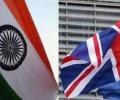
Officials from India and the United Kingdom (UK) are working overtime to address the contentious issues related to the proposed free trade agreement (FTA) between the two nations, in a final push to conclude the deal by the year-end. Commerce secretary Sunil Barthwal was headed to London on Thursday after completing his four-day visit to Brazil. Other key officials from India's negotiating team will be joining Barthwal in the UK capital, hoping to make headway in the FTA negotiations, which started in January last year, a person aware of the matter told Business Standard.

India and Chile will begin in August negotiations on the proposed preferential trade agreement to enhance bilateral trade which stood at $320 million in 2003.

China Eastern Airlines has resumed its Shanghai-Delhi service after a five-year gap, marking the first mainland Chinese carrier to restore direct flights to India this year. The resumption follows the resolution of border tensions and aims to boost trade, economic, and cultural exchanges between the two countries.

Pakistan's Army Chief Field Marshal Asim Munir met with Chinese President Xi Jinping, along with Pakistani Prime Minister Shehbaz Sharif, to discuss bilateral and regional cooperation. The meeting occurred during Sharif's visit to China for the Shanghai Cooperation Organisation (SCO) summit.

'Pakistan is an ally who gives the US access.' 'If we have a presence there, it puts us that much closer to China and puts our assets closer to China and Iran.'

Nine years after New Delhi started implementing its Plan B - bilateral trade agreements - to beat the impasse at the World Trade Organisation's Doha Round of liberalisation talks, India seems to be finally rolling.

The negotiations on a EU-US FTA will set the standards not only for the future transatlantic trade and investment, including regulatory issues, but also for the development of global trade rules.
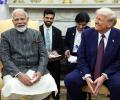
Congress general secretary Jairam Ramesh said Modi should take inspiration from former prime minister Indira Gandhi and stand up to the president of the United States.
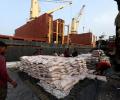
March 31 marked 10 years since the Modi government introduced its first Foreign Trade Policy (FTP 2015-20) that lasted for 8 years before the current FTP 2023 came in. Here is a brief assessment. In 2015, the government said that it aims to increase India's exports of merchandise and services from $465.9 billion in 2013-14 to approximately $900 billion by 2019-20 and to raise India's share in world exports from 2 per cent to 3.5 per cent.

'As the global economy undergoes significant transformations in 2025, India's ability to navigate the complexities of trade wars, financial realignments, and emerging blocs will be pivotal,' explain Harsh V Pant and Soumya Bhowmik.

The commerce ministry is working on different scenarios to assess the possible fallout of reciprocal tariffs to be imposed by the US administration on April 2 on its key trading partners including India, sources said. US President Donald Trump has said that April 2 will be 'Liberation Day' as he plans to announce tariffs or import duties to bring down America's trade deficit, and promote the country's manufacturing.
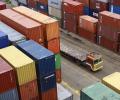
The US Trade Representative noted that India's average applied tariff rate stood at 17% per cent, the highest of any major world economy.

The two countries also signed a 'Memorandum of Agreement regarding the Assignment of Liaison Officers', which will facilitate the posting of one military officer from each country with the military of the other.

The Indian government has expressed its disagreement with the IMF staff's 'baseline' assumption that the 50 per cent US tariffs on its goods exports 'would remain in place indefinitely', based on which the staff pegged the country's GDP growth at 6.6 per cent this year, and pared its 2026-27 projection by 20 basis points to 6.2 per cent.

While India's export to China stood at only $13.52 billion in 2012-13, its imports from that country aggregated $54.3 billion, leaving a trade deficit of $40.78 billion during the last fiscal.

The government on Tuesday approved the draft of India's free trade agreement with Japan, which is likely to be signed during Prime Minister Manmohan Singh's visit to Tokyo later this month.

'Pakistan has found itself in a favourable position after Operation Sindoor by appreciating the mediation as claimed by Trump and recommending him for the Nobel Peace Prize.'

Prime Minister Narendra Modi is likely to visit the United Kingdom by the end of this month, with the India-UK free trade deal expected to be formally signed. Discussions on expanding bilateral ties in defence and security are also anticipated.

Japan is expected to increase its investment target in India from the earlier 5 trillion yen ($34 billion) to almost 10 trillion yen.

Khaleda Zia, the former Prime Minister of Bangladesh and a dominant figure in the country's politics, has died at the age of 80 after a prolonged illness. Her career spanned decades and included periods of both power and controversy.
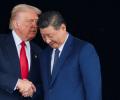
Speaking to reporters aboard Air Force One, Trump stated, "We have a deal," referring to the trade pact which will be routinely extended. "Every year we'll renegotiate the deal, but I think the deal will go on for a long time, long beyond the year. We'll negotiate at the end of the year," he added.
In what looks like a game-changer in ties between India and Pakistan, the two countries on Thursday vowed to take their $2-billion bilateral trade to the next level.
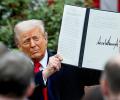
'April 9 announcement of slapping a 125% tariff on Chinese goods has brought the focus back to China, making this new phase feel like a repeat of the original conflict.'
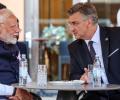
In his media statement following talks with his Croatian counterpart Andrej Plenkovic, Modi said both leaders agree that "terrorism is an enemy of humanity" and is inimical to forces that believe in democracy.

Reserve Bank and the finance ministry on Wednesday asked top management of banks and representative of trade bodies to push exports and import transactions in rupee. It was stressed during a meeting that banks should connect with their foreign counterparts for opening special rupee vastro accounts to facilitate cross-border trade in Indian currency rather than popular mode dollar, sources said. Trade associations and their foreign trading partners should explore opportunities to make use of the framework, sources added.
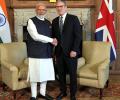
For UK automakers, market access to India will be limited by quantity caps and phased tariff cuts, especially on petrol, diesel and electric vehicles.

India is in talks with members of the Gulf Cooperation Council (GCC) to conclude a free trade agreement and a framework agreement for the FTA has already been signed, a leading Indian banker in the region has said.
Industry body Assocham estimates that trade between India and Pakistan can touch the $10 billion mark by 2010 from $345 million in 2003-04, provided the execution of South Asian Free Trade Agreement is not thwarted and the trade basket is diversified
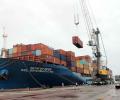
Industry associations and companies in the United States, including the US Chamber of Commerce, Coalition of Services Industries and the iconic bike company Harley Davidson have called on the Donald Trump dispensation to push India to reduce tariffs, non-tariffs, and regulatory barriers to boost American exports.
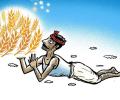
India's policy for agriculture trade must move commodity-by-commodity to gain maximum benefits as US President Donald Trump's 26 per cent tariff on exports from the country take effect, said agriculture economist Ashok Gulati in a recent policy paper.
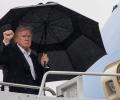
'When Prime Minister Modi met President Trump, they agreed to initiate a bilateral trade dialogue.' 'It makes sense to give these negotiations a chance.'
Taiwan said on Friday it is looking at the possibility of a Free Trade Agreement with India as part of initiatives to increase bilateral trade to $10 billion in the next few years from $2.4 billion in 2004.

The proposed India-Israel trade pact should be beneficial to both nations and until New Delhi gets a good deal, it would not do an agreement, Commerce and Industry Minister Piyush Goyal said. India and Israel are negotiating a free trade agreement (FTA) since May 2010. "With Israel, until we get a good deal, we will not do an FTA. It has to be reciprocally beneficial," the minister said in San Francisco on Tuesday while interacting with the Indian community.

In the short run, the Trump presidency has already ensured one thing: The assumptions of the past can no longer guide the strategies of the future, points out Manish Dabhade.

Bangladesh provides huge business opportunties in different sectors and Indian companies should explore areas of investments, Bangladesh Commerce Minister Tipu Munshi said on Tuesday. He said that government policies in Bangladesh are in favour of businesses. "Please do come and invest in Bangladesh," Munshi said in New Delhi while addressing businesses of both the countries.
